
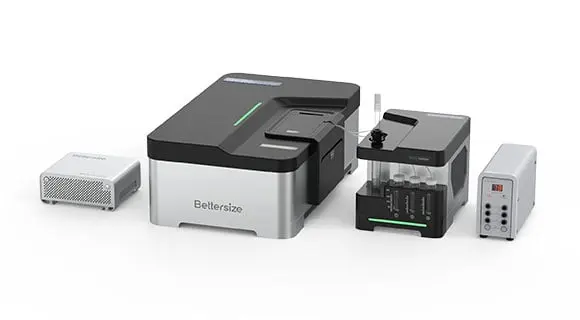
In the fields of nanotechnology, modern pharmaceuticals and biotechnology, work with materials takes place at the submicron level. When the particle size is less than one micron, classical laser diffraction methods become less efficient, requiring the use of specialized technologies such as dynamic light scattering. The BeNano 90 Zeta represents the gold standard in this category, offering researchers a proven, stable and highly accurate tool for studying colloidal systems. This device allows not only to find out the exact size of nanoparticles, but also to understand their behavior and stability over time by measuring the zeta potential.
The BeNano 90 Zeta uses dynamic light scattering (DLS), also known as photon correlation spectroscopy, to measure particle size. The instrument captures fluctuations in light intensity caused by the chaotic movement of particles in a liquid, known as Brownian motion. The measurement is performed at a fixed 90-degree angle using a highly sensitive photomultiplier tube (PMT) detector and a stable solid-state laser. This classic geometry ensures excellent signal-to-noise ratio when studying samples of standard concentrations. The obtained data is processed using advanced mathematical algorithms that allow determining not only the average hydrodynamic diameter of the particles, but also the polydispersity index (PDI), which indicates whether the particles in the solution are of uniform size.
The second essential function of the device is the measurement of zeta potential, which is performed using electrophoretic light scattering (ELS). When an electric field is applied to a solution, charged particles begin to move towards an electrode of opposite charge. The speed of this movement directly depends on the surface charge of the particles – the zeta potential. BeNano 90 Zeta uses revolutionary PALS (Phase Analysis Light Scattering) technology, which allows measuring the charge of even very low-mobility particles, for example, in the presence of high solution viscosity or in organic solvents. Knowing the zeta potential allows researchers to accurately predict whether an emulsion or suspension will remain stable, or whether the particles will clump and precipitate over time.
In addition to size and charge, this versatile device can measure static light scattering (SLS), which allows the determination of the absolute molecular weight of macromolecules such as proteins or synthetic polymers using Debye plots. All these measurements are performed in a very small volume - the device requires only a few microliters of sample, which is especially important when working with expensive or limited-quantity raw materials and pharmaceuticals.
The system integrates a highly accurate temperature control system operating in the temperature range from 0 °C to 90 °C. Since the viscosity of the liquid and the Brownian motion speed directly depend on the temperature, its precise maintenance (with an accuracy of up to 0.1 °C) guarantees the stability of the results. In addition, it allows for temperature studies, for example, to monitor protein denaturation or changes in the structure of polymers upon heating. The intelligent software has an automatic quality expertise module, which after each measurement assesses the reliability of the data obtained and provides recommendations to the operator, making the device accessible even to inexperienced users.
| Main specifications | Technical parameters |
| Particle size range | from 0.3 nm to 5000 nm |
| Zeta potential range | No limits (-500 mV to +500 mV) |
| Measuring angle (DLS) | 90 degrees |
| Temperature control | from 0 °C to 90 °C (accuracy 0.1 °C) |
| Minimum sample volume | From 20 μl |
| Applied technologies | DLS, ELS, PALS, SLS |
 EN
EN  LT
LT  LV
LV