
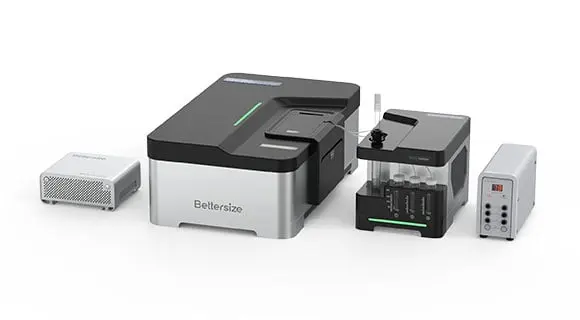
In today’s nanotechnology and biopharmaceutical industries, the ability to accurately characterize nanoparticles is essential for successful product development. Classical measurement methods often face technical challenges when it comes to studying extremely small particles or highly concentrated systems such as vaccines, protein solutions or inks. The BeNano 180 Zeta Max was designed to overcome these challenges, offering researchers revolutionary technical performance and the widest range of functionalities in a single device. This device combines several advanced optical techniques to provide complete information on the hydrodynamic size, surface charge and molecular weight of nanoparticles.
The main technical advantage of this model is the patented backscattering optical system, which captures light signals at an angle of 173 degrees. Traditional systems, which measure only at an angle of 90 degrees, often suffer from the multiple scattering effect, when light is reflected from several particles in a row, which is why concentrated samples must be heavily diluted. Dilution can irreversibly change the structure and aggregation state of sensitive samples, such as liposomes or polymeric micelles. The backscattering technology of the BeNano 180 Zeta Max drastically shortens the light path through the sample, allowing the device to accurately measure systems with concentrations of up to 40 percent by volume. In addition, this system is characterized by exceptional sensitivity, allowing the detection of particles as small as 0.3 nanometers.
The device uses electrophoretic light scattering (ELS) supplemented with PALS (Phase Analysis Light Scattering) technology to measure zeta potential. The traditional ELS method only records the frequency shift of particle motion in an electric field, but PALS analyzes the phase shift of light, which is a much more sensitive parameter. This allows the BeNano 180 Zeta Max to successfully measure zeta potential even in cases where particles move extremely slowly due to high medium viscosity or low surface charge. This feature is critically important in assessing the stability of pharmaceutical formulations, as it allows researchers to accurately determine the isoelectric point and predict how the product will behave during storage.
The instrument is equipped with a static light scattering (SLS) function for molecular weight determination. By measuring the intensity of scattered light at different sample concentrations, the software automatically generates Debye plots and calculates the absolute molecular weight and second virial coefficient of macromolecules or proteins. This eliminates the need for complex and time-consuming chromatographic procedures in routine polymer quality checks.
The device has an integrated ultra-wide temperature control system, operating from minus 15 to plus 120 degrees Celsius. Such a wide range makes it possible to perform unique temperature studies, for example, to monitor the exact temperature of protein denaturation or polymer gelation in real time. The software is designed with user convenience in mind, and it includes a smart algorithm filter that automatically detects and removes signal distortions caused by dust or other large environmental contaminants, ensuring the highest repeatability of results.
| Main specifications | Technical parameters |
| Size measurement range | from 0.3 nm to 15,000 nm |
| Zeta potential range | from -500 mV to +500 mV |
| Measuring angles | 173 degrees (backscatter) and 90 degrees |
| Temperature control | from -15°C to 120°C |
| Minimum sample volume | from 3 hadi 20 μl |
| Compliance with standards | ISO 22412, ISO 13099 |
 EN
EN  LT
LT  LV
LV