
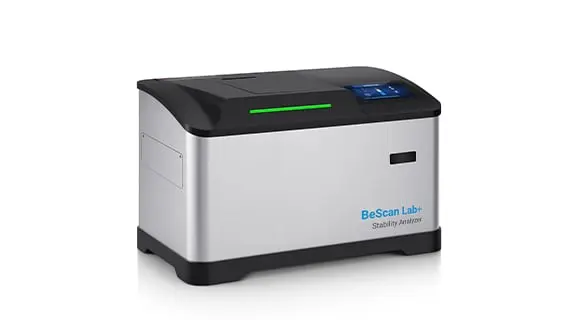
When developing new liquid products, such as cosmetic creams, food dressings, pharmaceutical suspensions or industrial paints, one of the biggest challenges is ensuring stability. The consumer expects the product to remain homogeneous throughout its shelf life, but the laws of gravity and thermodynamics constantly encourage particles to settle, rise or combine into larger formations. Traditional stability testing, based on storing samples on shelves and visual observation, takes months or even years, which significantly slows down the introduction of new products to the market. BeScan Lab overcomes this time constraint by allowing you to see microscopic changes in stability within hours or days.
The operating principle of the device is based on the advanced SMLS (Static Multiple Light Scattering) technology. During the measurement, a vertically moving optical head, consisting of a near-infrared light source and two detectors, scans a glass vial with a sample over its entire height. One detector records the light that has passed through the sample (transmission), and the second one records the light that has been scattered back (backscattering). Scanning is performed periodically at certain time intervals. If particle migration occurs in the sample (for example, settling to the bottom), the light scattering profile in the upper and lower parts of the vial begins to change. If particle size changes (flocculation or coalescence) occur, the total scattering intensity over the entire height of the sample changes.
A huge advantage of BeScan Lab is that it analyzes the sample without any mechanical or chemical damage. Unlike centrifugation methods, which create artificial mechanical forces and can destroy fragile gel structures, SMLS technology captures natural processes. In addition, the device can analyze highly concentrated samples (up to 95% by volume), which is not possible using standard microscopes or laser diffraction devices without strong dilution.
The device is equipped with a powerful thermal camera that allows you to maintain a constant temperature or program its changes up to 80 degrees Celsius. When the temperature is increased, the viscosity of the liquid decreases and the movement of particles intensifies, which allows you to artificially simulate and accelerate the long-term storage of a product in hot climate conditions. This allows researchers to determine within a few days how a cosmetic lotion or paint emulsion will behave after a year in storage.
The software performs complex calculations and provides the user with not only dispersion graphs, but also a very clear kinetic indicator - TSI (Turbiscan Stability Index / Instability Index). This index is a single numerical value that sums up all the changes that have occurred in the sample. The lower the TSI number and the slower it rises over time, the more stable the product is. Using this indicator, formulators can objectively compare several dozen different stabilizer or thickener options and quickly choose the most effective solution, drastically shortening the product development cycle.
| Main specifications | Technical parameters |
| Measurement technology | SMLS (Static Multiple Light Scattering) |
| Light source | Infrared laser (850 nm) |
| Sample concentration limits | from 0.0001 % to 95 % by volume |
| Sample volume | Standard 20 ml glass vials |
| Temperature range | from ambient temperature to 80 °C |
| Analyzing phenomena | Sedimentation, chalking, flocculation, phase separation |
 EN
EN  LT
LT  LV
LV