
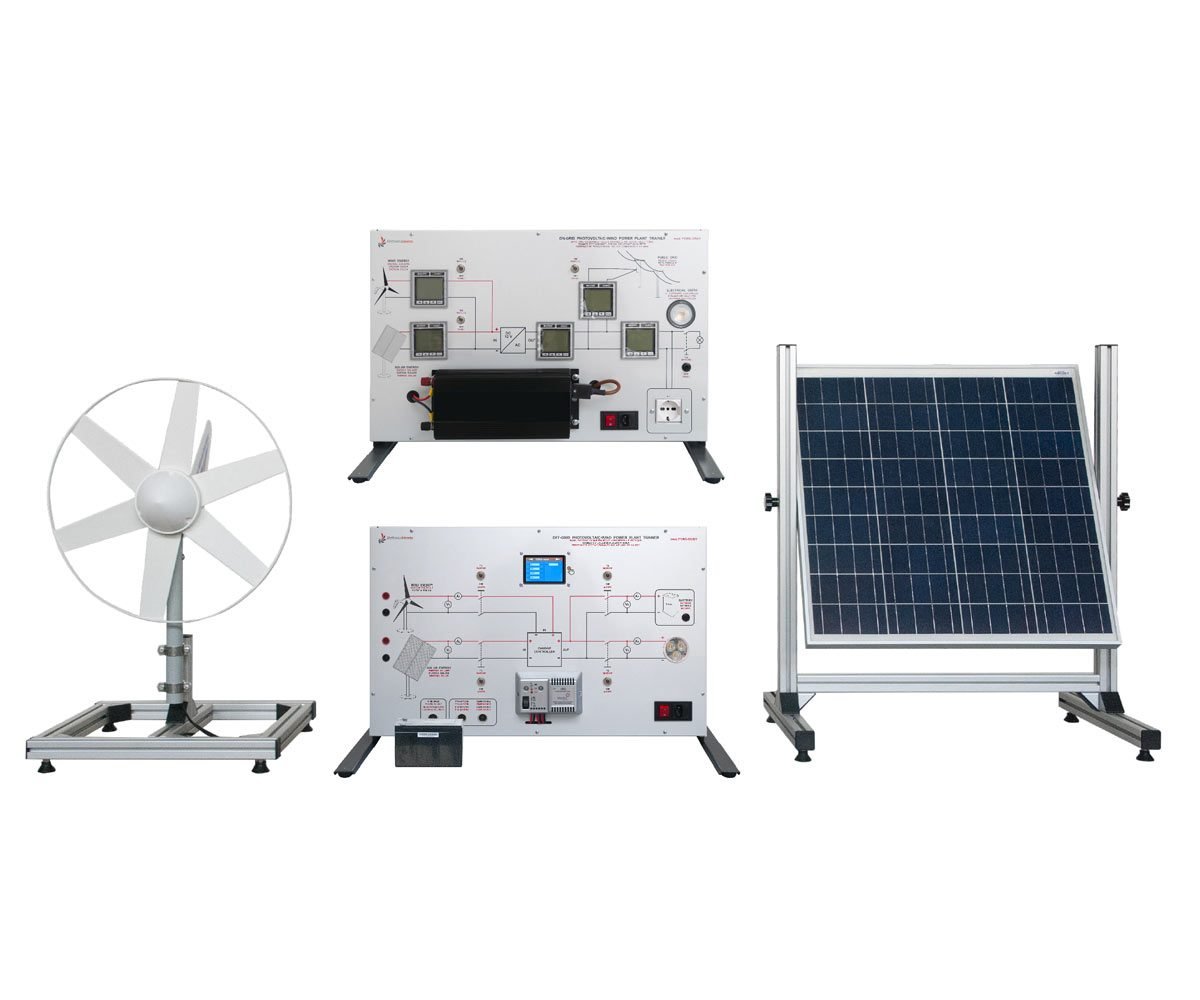
Autonomous photovoltaic solar and wind energy system PVWG/EV – is a unique training system that allows you to analyze and understand how solar and wind energy is converted to electricity in both autonomous (OFF-GRID) and network (ON-GRID) modes. This simulator is suitable for practical learning, energy flow analysis and energy efficiency research.
Main features:
- Operating modes:
- Autonomous (OFF-GRID):
- Excess energy charges the buffer battery.
- Consumer energy is supplied from the sun, wind or battery (in case of energy shortage).
- Network (ON-GRID):
- Surplus energy is fed into the electricity grid.
- The missing energy is supplied from the grid.
- Autonomous (OFF-GRID):
- Solar photovoltaic module:
- 60 W silicon solar panel with adjustable aluminum frame.
- Solar radiation sensor (0–2000 W/m²).
- Temperature sensor (-50–+70 °C).
- Wind turbine:
- Horizontal axis generator with 6 blades and a 510 mm diameter rotor.
- Rated power: 49 W at 15 m/s wind speed.
- Low-friction, brushless three-phase generator (12 V DC).
- Control systems:
- Standalone control panel:
- PWM charge controller with LED indicators.
- 12 V DC load (light bulb).
- DC parameter display (microprocessor, touch screen).
- Network mode control panel:
- Mains inverter (450 W, 230 V, 50 Hz, pure sine wave output).
- 230 V AC load (light bulb).
- Standalone control panel:
- Backup battery:
- Voltage: 12V DC.
- Capacity: 12 Ah.
- Data collection and analysis:
- USB interface and LabView-based software for parameter monitoring.
- Monitored parameters: solar radiation, panel temperature, wind speed, DC/AC parameters, energy flows.
- The software allows you to analyze energy conversion efficiency, monitor energy flow trends, and store data for the future.
Training programs include:
- Principles of solar and wind energy conversion.
- The influence of solar radiation and shadow on the voltage of a photovoltaic panel.
- The influence of wind speed on the generator output voltage.
- Energy conversion efficiency analysis.
- Battery charging management.
- Power supply to the grid and DC/AC inverter efficiency.
Dimensions and weight:
- Control panels: 80 x 40 x 15 cm.
- Solar panel: 70 x 70 x 5 cm.
- Wind turbine diameter: 51 cm.
- Total weight: 60 kg.



 EN
EN  LT
LT  LV
LV