

„Bettersize Instruments Ltd. BeNano 180 Zeta Pro Nanoparticle Size and Zeta Potential Analyzer
The BeNano Series is the latest generation of nanoparticle size and zeta potential analyzers developed by Bettersize Instruments. Dynamic light scattering (DLS), electrophoretic light scattering (ELS) and static light scattering (SLS) are integrated into the system, providing accurate measurements of nanoparticle size, zeta potential and molecular weight. The BeNano Series is widely applied in academic and manufacturing processes in various fields, including but not limited to: chemical engineering, pharmaceuticals, food and beverage industries, inks and pigments, life sciences, etc.
- Features and benefits:
- Size range: 0.3nm – 15μm
- Minimum sample volume 3μL
- APD (Avalanche Photodiode) detector providing exceptional sensitivity
- Automatic laser intensity adjustment
- Smart result evaluation algorithm
- DLS backscatter (173°) detection technology
- User-adjustable dispersion volume for concentrated samples
- PALS (Phase Analysis Light Scattering) technology
- Programmable temperature control system
- Complies with 21 CFR Part 11, ISO 22412, ISO 13099
- Unlock the Growing Potential of Research with BeNano
- Zoomable ELS Technology: PALS
PALS technology effectively separates and distinguishes electrophoretic behavior even in the case of weakly moving samples near the isoelectric point or in the presence of high salt content. - Zoomable DLS Technology: Backscatter Detection
Backscatter DLS optics can detect a much larger scattering volume compared to 90-degree optics. Combined with a movable measurement position, backscatter DLS offers much higher sensitivity and the ability to measure highly turbid samples. - Temperature Trend Measurement
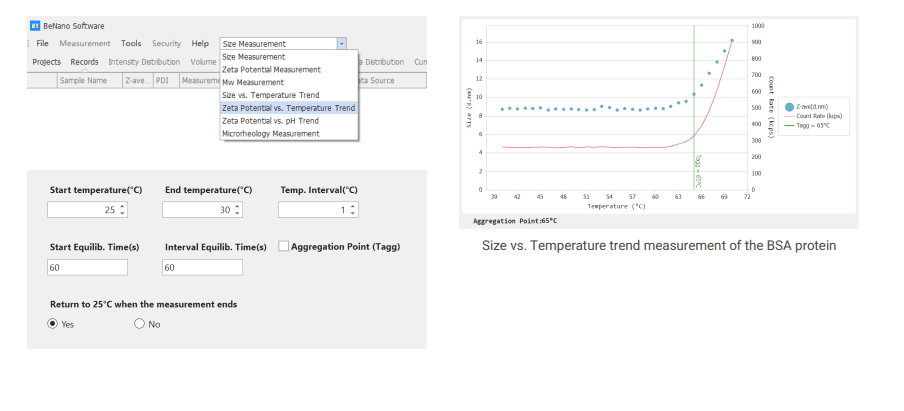
For oil-sensitive samples, temperature trend measurement can be easily performed with a programmed SOP. BeNano can determine the temperature transition point of the size results, which is the aggregation temperature of protein samples. - Stable and Durable Optical Seat
BeNano uses a 50mW solid-state laser, a unidirectional fiber system, and a high-performance APD detector, providing stable, wide-ranging, and highly reliable detection capability. - Research Level Software
BeNano software can intelligently evaluate and process scattered light signals to improve signal quality and result stability. Various built-in calculation modes can cover a wide range of research and application areas. - Very Small Sample Volume Required
Low sample volume measurement is essential for early stage R&D in the pharmaceutical industry and academia. With a capillary measuring cell, only 3-5 μl of sample is required for accurate size measurement.
- Zoomable ELS Technology: PALS
- Dynamic Light Scattering (DLS) Object Size
Dynamic light scattering (DLS), also known as photon correlation spectroscopy (PCS) or quasi-elastic light scattering (QELS), is a technique for measuring Brownian motion in a dispersant. It is based on the principle that smaller particles move faster and larger particles move slower. The scattering intensities of the particles are detected by an avalanche photodiode (APD) and then converted into a correlation function using a correlator. From this correlation function, the diffusion coefficient (D) is measured.

The hydrodynamic diameter (DH) and its distribution can be calculated using the Stokes-Einstein equation, which relates the diffusion coefficient to the particle size.

- Backscatter Detection Technology
- Wide Concentration Range
By optimizing the detection position, highly concentrated samples can be detected near the edge of the sample cell, effectively minimizing the effects of multiple light scattering. - Higher Sensitivity
8-10 times larger scattering volume and about 10 times higher sensitivity compared to traditional 90° optical design. - Higher Size Upper Limit
It reduces multiple light scattering effects from large particles and to some extent reduces the fluctuation in the number of large particles due to the much larger scattering volume. - Better Repeatability
DLS backscatter technology is less affected by dust impurities and unevenly distributed agglomerates, providing better repeatability.
The intelligent search for optimal detection position function automatically determines the optimal detection position based on sample size, concentration and scattering ability, to achieve the highest measurement accuracy and offer flexibility in detecting various sample types and concentrations. This function is especially useful when handling a variety of samples, each with its own unique scattering properties and concentrations.

- Wide Concentration Range
- Zeta Potential Measurement by Electrophoretic Light Scattering (ELS)
In aqueous systems, charged particles are surrounded by counterions that form an inner Stern layer and an outer axial layer. Zeta potential is the electrical potential at the axial layer interface. Increasing zeta potential indicates greater stability and less aggregation in a suspension system. Electrophoretic light scattering (ELS) measures electrophoretic mobility through Doppler shifts of scattered light, which can be used to determine the zeta potential of a sample according to Henry's equation.


- Phase Analysis Light Scattering (PALS)
- Precise measurement technology for samples with low electrophoretic mobility
- Effective for samples in organic solvents with low dielectric properties
- More reliable results with samples with high conductivity

- Static Light Scattering (SLS)
Static light scattering (SLS) is a technology that measures the scattering intensity, weight average molecular weight (Mw) and the second virial coefficient (A2), using the Rayleigh equation:

Where c is the sample concentration, θ is the detection angle, Rθ is the Rayleigh ratio used to define the ratio of the intensity of scattered light to the incident light at an angle θ, Mw is the weight average molecular weight of the sample, A2 is the second virial coefficient, and K is with (dn/dc)2 related constant.
During molecular weight measurement, the scattering intensities of the sample at different concentrations are detected. Using the scattering intensity and Rayleigh ratio of a known standard (e.g., toluene), the Rayleigh ratio values of the sample at different concentrations are calculated and plotted on a Debye diagram. The molecular weight and the second virial coefficient are then obtained from the intercept and slope of the linear regression of the Debye diagram.


- Microrheology measured by DLS
Microrheology measured by dynamic light scattering (DLS Microrheology) is an economical and efficient technique that uses dynamic light scattering to determine rheological properties. By analyzing the Brownian motion of colloidal observer particles, information can be obtained about the viscoelastic properties of the system, such as viscoelastic modulus, complex viscosity, and bending modulus, using the generalized Stokes-Einstein equation.

- Features and benefits:
- Studies rheological properties by measuring the motion of thermally driven observer particles in the material being studied
- Facilitates measurements over a wide frequency range
- Applies a small voltage to the observer particles
- Only a microliter sample volume is required
- Adds mechanical rheology information
- Suitable for weakly structured samples
- Temperature trend measurement
- Measurement parameters:
- Size vs. Temperature
- Zeta potential vs. temperature
- Features:
- Used to test the stability of protein formula
- Promotes real-time aging by increasing temperature
- Benefit:
- Simple protein formula stability test
- Real-time aging promotion by increasing temperature
- Measurement parameters:
- pH trend measurement
- Measurement parameters:
- Zeta potential vs. pH
- Isoelectric point
- Irritability vs. pH
- Features:
- High-precision tertiary titration pumps
- Controlled peristaltic pump with high flow and speed
- General purpose electrode
- Automated solution selection based on initial and target pH values using intelligent software
- Benefit:
- It takes less time to take measurements
- Improves consistency and repeatability of results
- Reduces the workload of researchers
- Simplifies operator qualification requirements
- Promotes real-time aging by increasing temperature
- Reduces contact with aggressive liquids

- Measurement parameters:
- Research-grade software
- SOP ensures accuracy and completeness of measurements
- Automatic calculation of mean and standard deviation for results and statistics
- Comparison of results from multiple measurements via statistics and tracking functions
- Real-time display of results and information
- Over 100 available parameters for research, quality control, quality assurance and production
- Free lifestyle upgrade opportunities

- Compliance with FDA 21 CFR Part 11
The BeNano software system complies with 21 CFR Part 11, which limits access to authorized individuals through a username and password system for electronic signature of records, access logs, change logs, or execution of actions. An activation code can be used to increase security settings and ensure compliance, and an „audit trail” allows for review of proper system security and data integrity.

Analyzers – Bettersize
More information: on the manufacturer's website or send us an inquiry!




 EN
EN  LT
LT  LV
LV